Risk Factors For Malignant Mesothelioma

Mesothelioma Risk Factors
There are several risk factors that increase the likelihood that a person will develop mesothelioma. The primary risk factor is asbestos exposure. Exposure to this very harmful substance can significantly enhance the chances of contracting the disease. Smoking does not have a direct causal relationship with mesothelioma but is a significant compounding factor and increases the chances of developing the disease. Other less common secondary factors include exposure to radiation, zeolite, simian virus 40 (SV40) and erionite. We discuss each of these risk factors in more detail below. Please click on the links to learn more about each mesothelioma risk factor.

Exposure to Asbestos

Exposure to asbestos is the leading risk factor associated with mesothelioma. Asbestos is an insulating material comprised of magnesium-silicate mineral fibers. It was favored by builders and contractors for many years for its low heat conductivity and resistance to melting and burning. Since researchers have identified more and more links between mesothelioma and exposure to asbestos, the material is now less widely used. Prior to this discovery, however, millions of Americans have experienced serious exposure to this harmful substance.

Smoking and Mesothelioma

Smoking alone is not linked to mesothelioma, but smokers who are exposed to asbestos have a much higher chance of developing asbestos lung cancer (as much as fifty to ninety percent higher) and as much as double the risk of developing mesothelioma.

Less Common Mesothelioma Risk Factors

Radiation

Thorium dioxide (Thorotrast), a substance used in x-ray tests in the past has reported links to pleural mesothelioma and peritoneal mesothelioma. The use of Thorotrast has been discontinued for many years due to this discovery.

Zeolite

Some mesothelioma cases in the Anatoli region within Turkey have been linked to Zeolite, a silica based mineral with chemical properties similar to asbestos found in the soil there.

Simian Virus 40 (SV40)

Some scientists have found the simian virus 40 (SV30) in mesothelioma cells from humans and have been able to create mesothelioma in animals with the virus. The relationship between this virus and mesothelioma is still unclear, however, and further research is being conducted to gain clarity on this potential link.

Erionite Exposure

Erionite is a naturally occurring mineral that possesses properties that are very similar to those of asbestos. There have been several documented cases of mesothelioma in indivuduals living near large erionite deposits.

Carbon Nanotubes

Researchers continue to evaluate nanotube exposure as a possible risk factor for mesothelioma even though scientists have not expressed immediate concern.

Malignant Mesothelioma

Malignant mesothelioma is the most serious of all asbestos-related diseases. The primary cause and risk factor for mesothelioma is exposure to asbestos.

Making a correct mesothelioma diagnosis is particularly difficult for doctors because the disease often presents with symptoms that mimic other common ailments. There is no known cure for mesothelioma, but treatments such as surgery and chemotherapy have helped to improve the typical mesothelioma prognosis.

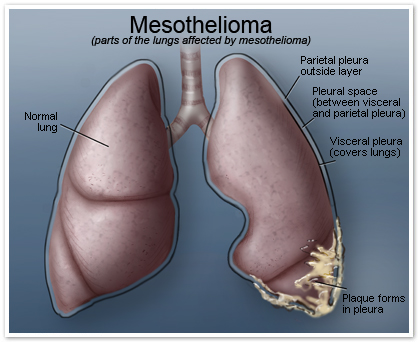
Pleural mesothelioma (affecting the lung’s protective lining in the chest cavity) represents about three quarters of all mesothelioma incidence. Peritoneal mesothelioma, which affects the abdominal cavity, and pericardial mesothelioma, which affects the cardiac cavity, comprise the remainder.
There are three recognized mesothelioma cell-types. Between 50 and 70% of all mesotheliomas are of the epithelial variety. While prognosis is generally poor, it is considered less aggressive than sarcomatoid mesothelioma and biphasic mesothelioma, which comprise the remainder of cell type diagnoses.

The cavities within the body encompassing the chest, abdomen, and heart are surround by a membrane of cells known as the mesothelium. Mesothelial cells assist in general organ functions. The mesothelium is particularly important to organs that are commonly in motion, such as expansion or contraction of the lungs, stomach, or heart. Lubrication from the mesothelial cells allows free range of motion within the body. The mesothelium of the chest, abdomen, and cardiac cavity are called the pleura, the peritoneum, and the pericardium, respectively. Each of these groupings of mesothelial cells is extremely critical to the functions of the body structures which they encompass.

Malignancies (cancerous tumors) occurring within the mesothelial membranes are known as malignant mesothelioma, or simply mesothelioma. Benign tumors of the mesothelium are known to occur, but are much more rare than malignant mesothelial tumors.

While tumors of the mesothelium were first recognized in the late 18th century, it was not until the middle of the 20th century that this particular cancer was studied and examined with more detail. It was at this time when suspicions of the cancer’s causal relationship with asbestos exposure became more substantiated. A joint research venture through the Department of Thoracic Surgery at the University of the Witswater and Johannesburg General Hospital in South Africa provided the most compelling evidence of the nexus between asbestos exposure and the development of pleural mesothelioma.

Incidence of mesothelioma is still quite rare, with only 2,500-3000 diagnoses in the United States each year. There was a spike in reported diagnoses between 1970 and 1984, which has been attributed to the latency period between diagnosis and the height of industrial exposures, which occurred roughly 40-60 years prior to this time. Exposure was common in nearly all industries but was particularly common in the WWII-era military industrial cycle, including Navy Shipyards.

Although this cancer is much more common in men over the age of 60 (largely attributed to the industrial exposures within male-dominated industries), mesothelioma in women and children has been described as well. Mesothelioma causes for diagnosis in women and children are mainly attributed to secondary exposure to asbestos, as it was not uncommon for men to bring asbestos back into the home on their body or clothing if proper cleaning facilities were not available on site.

Mesothelioma is diagnosed through a comprehensive combination of biopsy and imaging scans.

Mesothelioma can be a difficult malignancy to diagnose because the symptoms of the disease closely resemble other respiratory conditions, and because the pathology can be very difficult to distinguish from adenocarcinoma of the lung. For this reason, misdiagnosis is not uncommon in mesothelioma patients. Symptoms of mesothelioma include chest pain, chronic cough, effusions of the chest and abdomen, and the presence of blood in lung fluid.

Diagnostic surgeries, including a biopsy, will typically be required to determine the type of malignant cells that are present in the body. Typically a body imaging scan, including a magnetic resonance image (MRI), computer topography (CT scan), and/or positron emission tomography (PET), will be required to determine the extent and location of the disease.

While mesothelioma is typically advanced at diagnosis, treatment options are available.

Mesothelioma, while certainly an aggressive disease, is a manageable malignancy. While there is no cure for the cancer, mesothelioma treatment options may potentially include surgery, chemotherapy, and radiation therapy. A combination of Alimta® and Cisplatin is currently the only FDA approved chemotherapy regimen, though several clinical trials are currently in progress utilizing other drugs including Gemcitabine and Onconase, that may lead to new treatment options that provide a benefit for patients.

Radiation therapy is also utilized, but typically in conjunction with other treatment methods like surgery and chemotherapy. Surgical resection of mesothelioma is possible in early-stage-diagnosed patients. Diagnostic and palliative procedures such as thoracentesis and pleurodesis are also commonly performed in patients with malignant mesothelioma in order to minimize cancer-related symptoms.

Alternative therapies have also been used effectively by many mesothelioma patients to assist in managing symptoms of the disease and conventional treatments.
Mesothelioma is caused by exposure to asbestos.

Mesothelioma is primarily caused by exposure to asbestos, though cases have been documented in children or other individuals with no asbestos history. Asbestos is a microscopic and naturally occurring mineral that lodges in the pleural lining of the lungs and the peritoneal lining of the abdominal cavity. In most cases, several years will pass (up to 60) before mesothelioma develops in those who had been exposed to asbestos.

Treating Menstrual Problems

To determine whether a problem requires treatment, the doctor will ask several questions and do a thorough physical exam. The doctor may do a pelvic exam, blood tests, or urine tests. If there might be a structural problem, an ultrasound or CAT scan may be performed. Together, these tests can help the doctor determine how a condition should be handled.

Growths such as polyps or fibroids can often be removed and endometriosis can often be treated with medications or surgery. If a hormone imbalance is to blame, the doctor may suggest hormone therapy with birth control pills or other hormone-containing medications. Conditions like clotting disorders or thyroid problems may require treatment as well. And for menstrual pain with no underlying medical cause, anti-inflammatory medicines are the most effective treatment.

When to Call the Doctor

Although most period problems aren't cause for alarm, certain symptoms do call for a trip to the doctor. This is particularly true if a girl's normal cycle changes.
So take your daughter to her doctor if she:
  • hasn't started her period by the time she's 15 or her period hasn't become regular after 3 years of menstruating. The most likely cause is a hormone imbalance (which may need treatment), but this also might point to another medical problem.
  • stops getting her period or it becomes irregular after it has been regular. Also let your daughter's doctor know if her cycle is less than 21 days or more than 45 days, or if she doesn't get a period for 3 months at any time after first beginning to menstruate.
  • has heavy or long periods, especially if she gets her period frequently. In some cases, significant blood loss can cause iron-deficiency anemia. Also, heavy bleeding could be a sign of a growth in the uterus, a thyroid condition, an infection, or a blood clotting problem.
  • has very painful periods. Having cramps for a couple of days is normal, but if your daughter isn't able to participate in her normal activities, or has cramps for more than 3 days, let the doctor know. She might have a medical problem, such as endometriosis, causing the pain.

Helping Your Daughter

When your daughter's experiencing a particularly bad bout of PMS or cramps, you can help make her more comfortable. Suggest that she:
  • eat a balanced diet with lots of fresh fruit and vegetables
  • reduce her intake of salt (which can cause water retention) and caffeine (which can make her jumpy and anxious)
  • include foods with calcium, which may reduce the severity of her PMS symptoms
  • try over-the-counter pain relievers like acetaminophen or ibuprofen for cramps, headaches, or back pain
  • take a brisk walk or bike ride to relieve stress and aches
  • soak in a warm bath or put a hot water bottle on her abdomen, which may help her relax
If you notice that your daughter's periods are causing her great discomfort or interfering with her life, talk to her doctor to make sure nothing else is causing the problem and to see if anything can help. Sometimes hormone treatment, often in the form of birth control pills, can help ease many symptoms associated with uncomfortable periods.

But the most important way you can help your daughter feel more at ease about her period is to talk to her and explain that most annoying or uncomfortable conditions that accompany menstruation are normal and may improve over time. And be understanding when she's cranky and unhappy. After all, no one's at her best all the time.

Source: kidshealth

Endometriosis

Endometriosis

In this condition, tissue normally found only in the uterus starts to grow outside the uterus — in the ovaries, fallopian tubes, or other parts of the pelvic cavity. It can cause abnormal bleeding, dysmenorrhea, general pelvic pain, and lower back pain.

Endometriosis is a gynecological medical condition in which cells from the lining of the uterus (endometrium) appear and flourish outside the uterine cavity, most commonly on the peritoneum which lines the abdominal cavity. The uterine cavity is lined with endometrial cells, which are under the influence of female hormones. Endometrial-like cells in areas outside the uterus (endometriosis) are influenced by hormonal changes and respond in a way that is similar to the cells found inside the uterus. Symptoms often worsen with the menstrual cycle.

Endometriosis is typically seen during the reproductive years; it has been estimated that endometriosis occurs in roughly 6–10% of women. Symptoms may depend on the site of active endometriosis. Its main but not universal symptom is pelvic pain in various manifestations. Endometriosis is a common finding in women with infertility.

Signs and symptoms

Pelvic pain

A major symptom of endometriosis is recurring pelvic pain. The pain can range from mild to severe cramping that occurs on both sides of the pelvis, in the lower back and rectal area, and even down the legs. The amount of pain a woman feels correlates poorly with the extent or stage (1 through 4) of endometriosis, with some women having little or no pain despite having extensive endometriosis or endometriosis with scarring, while other women may have severe pain even though they have only a few small areas of endometriosis 

Symptoms of endometriosis-related pain may include:
  • dysmenorrhea – painful, sometimes disabling cramps during menses; pain may get worse over time (progressive pain), also lower back pains linked to the pelvis
  • chronic pelvic pain – typically accompanied by lower back pain or abdominal pain
  • dyspareunia – painful sex
  • dysuria – urinary urgency, frequency, and sometimes painful voiding
Throbbing, gnawing, and dragging pain to the legs are reported more commonly by women with endometriosis. Compared with women with superficial endometriosis, those with deep disease appear to be more likely to report shooting rectal pain and a sense of their insides being pulled down. Individual pain areas and pain intensity appears to be unrelated to the surgical diagnosis, and the area of pain unrelated to area of endometriosis.

Endometriosis lesions react to hormonal stimulation and may "bleed" at the time of menstruation. The blood accumulates locally, causes swelling, and triggers inflammatory responses with the activation of cytokines. This process may cause pain. Pain can also occur from adhesions (internal scar tissue) binding internal organs to each other, causing organ dislocation. Fallopian tubes, ovaries, the uterus, the bowels, and the bladder can be bound together in ways that are painful on a daily basis, not just during menstrual periods.

Also, endometriotic lesions can develop their own nerve supply, thereby creating a direct and two-way interaction between lesions and the central nervous system, potentially producing a variety of individual differences in pain that can, in some women, become independent of the disease itself.


Dysmenorrhea

Dysmenorrhea (Painful Periods)

There are two types of dysmenorrhea, which is painful menstruation that can interfere with a girl's ability to attend school, study, or sleep:
  1. Primary dysmenorrhea is very common in teens and is not caused by a disease or other condition. Instead, the culprit is prostaglandin, the chemical behind cramps. Some prostaglandin can lead to mild cramps. But large amounts of prostaglandin can lead to nausea, vomiting, headaches, backaches, diarrhea, and severe cramps. Fortunately, these symptoms usually only last for a day or two.

  2. Secondary dysmenorrhea is pain caused by some physical condition like polyps or fibroids in the uterus, endometriosis, pelvic inflammatory disease (PID), or adenomyosis (tissue that usually lines the uterus growing into the muscular wall of the uterus).
Having cramps for a day or two each month is common, but if your daughter has symptoms severe enough to keep her from her normal activities, or cramps that last for more than 3 days, discuss it with her doctor.

Menorrhagia

Menorrhagia (Extremely Heavy, Prolonged Periods)

It's normal for a girl's period to be heavier on some days than others. But signs of menorrhagia (excessively heavy or long periods) can include soaking through at least one sanitary napkin (pad) an hour for several hours in a row or periods that last longer than 7 days. Girls with menorrhagia sometimes stay home from school or social functions because they're worried they won't be able to control the bleeding in public.

The most frequent cause of menorrhagia is an imbalance between the levels of estrogen and progesterone in the body, which allows the endometrium (the lining of the uterus) to keep building up. When the endometrium is finally shed during menstruation, the resulting bleeding is particularly heavy.

Because many adolescents have slight hormone imbalances during puberty, menorrhagia isn't uncommon in teens. But in some cases, heavy menstrual bleeding can be caused by problems such as:
  • fibroids (benign growths) or polyps in the uterus
  • thyroid conditions
  • clotting disorders
  • inflammation or infection in the vagina or cervix
If your daughter has heavy periods, or periods that last longer than 7 days, talk to her doctor.

Source: kidshealth